Okta governs the access. aizome governs the action.
Okta decides which agent may connect to what, under whose authority. aizome decides whether what that agent is doing right now is still the job it was given.
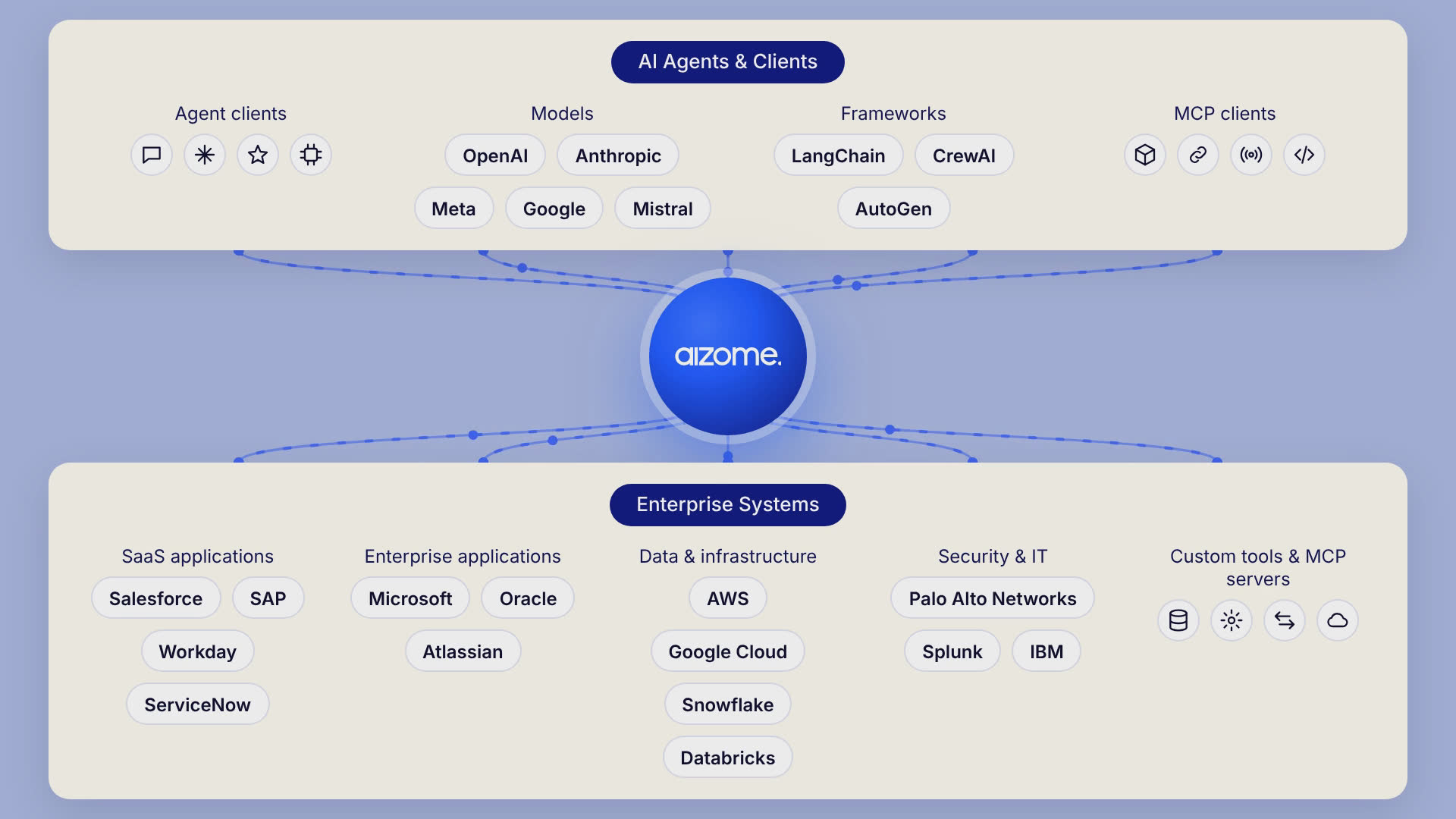
aizome is the Identity-first AI Governance Platform. It sits as a single secure exchange (AI Gateway) between every AI agent your workforce deploys and every enterprise system those agents access, governing identity, enforcing intent, controlling cost, and making every agent accountable from day one.
What is Okta for AI Agents?
Okta for AI Agents extends Okta’s identity platform to agents: Agent SSO and the Cross App Access protocol for governed agent-to-app connections, Agent Gateway for runtime tool-level control, endpoint discovery for shadow agents, and identity threat detection through its Permiso acquisition.
Access answers who. Intent answers whether.
Okta establishes that an agent is authorized to reach an application, under a named user’s authority, with scoped and short-lived tokens. That is the right foundation and it closes a real gap. It does not answer the next question. An agent authorized to read supplier records in your ERP is still authorized when it reads them for the wrong reason, when a document it processed told it to, or when it keeps going past the task it was given. Every one of those actions is inside its access. Okta’s own roadmap places the answer in 2027. Independent analysis of Oktane 2026 lists semantic intent validation and ephemeral task tokens under intent-aware authorization, with a 2027 timeframe, and notes these should be distinguished from currently deployable controls. aizome evaluates each action against the purpose the agent was given, before it executes. Today.
Where each layer acts
(Okta for AI Agents)
Agent Identity
(Okta for AI Agents)Agent SSO and Cross App Access, generally available
Six-stage SAML impersonation through your IdP
Agent Discovery
(Okta for AI Agents)Endpoint discovery via CrowdStrike, early access
Every agent connecting to an enterprise system
Runtime enforcement
(Okta for AI Agents)Agent Gateway, generally available for traffic routed through it
Inline on every call, including systems with no gateway
Entitlement
(Okta for AI Agents)Scoped tokens for governed connections
Ceiling set at what the human can do, evaluated behind the tool
Intent
(Okta for AI Agents)Semantic intent validation, 2027 roadmap
Every action checked against declared purpose before execution - today
Cost
(Okta for AI Agents)Outside the model
Per-session token limits, cost drift detection
Data protection
(Okta for AI Agents)Not provided natively; context from partners
12 categories plus custom patterns, masked and blocked inline
Audit
(Okta for AI Agents)Session traces and runtime telemetry
Identity to tool call to outcome, tamper evident
What aizome adds
Intent, not just authorization
Every action compared with the agent’s declared purpose. Drift into tools it was never meant to use, instructions sourced from content it read, and runaway loops are caught as what they are.
Data inside the response
Twelve data categories plus your own patterns, masked in tool results before the model reads them and blocked in outbound calls.
Reach past the gateway
A gateway governs what routes through it. aizome connects agents to your core, your ERP, and systems with no modern API, where no gateway integration exists.
Frequently asked questions
No, and it cannot. aizome depends on your identity provider. Okta establishes who the user is and governs which agents may connect. aizome governs what the agent does once connected.
Agent Gateway is real runtime enforcement and a significant step. The difference is what is evaluated at that moment. Okta checks whether the tool call is permitted. aizome checks whether it fits the job the agent was given, which is the capability Okta’s own roadmap schedules for 2027.
That is a legitimate choice if your agents are low-risk. Independent analysis of Oktane recommends that organizations running production agents with sensitive-data access or privileged tool calls consider specialist runtime controls in the meantime.
No. aizome deploys into your own AWS VPC.
See every agent and what it is reaching for.
Thirty minutes, your environment. We will show you the agents nobody registered.